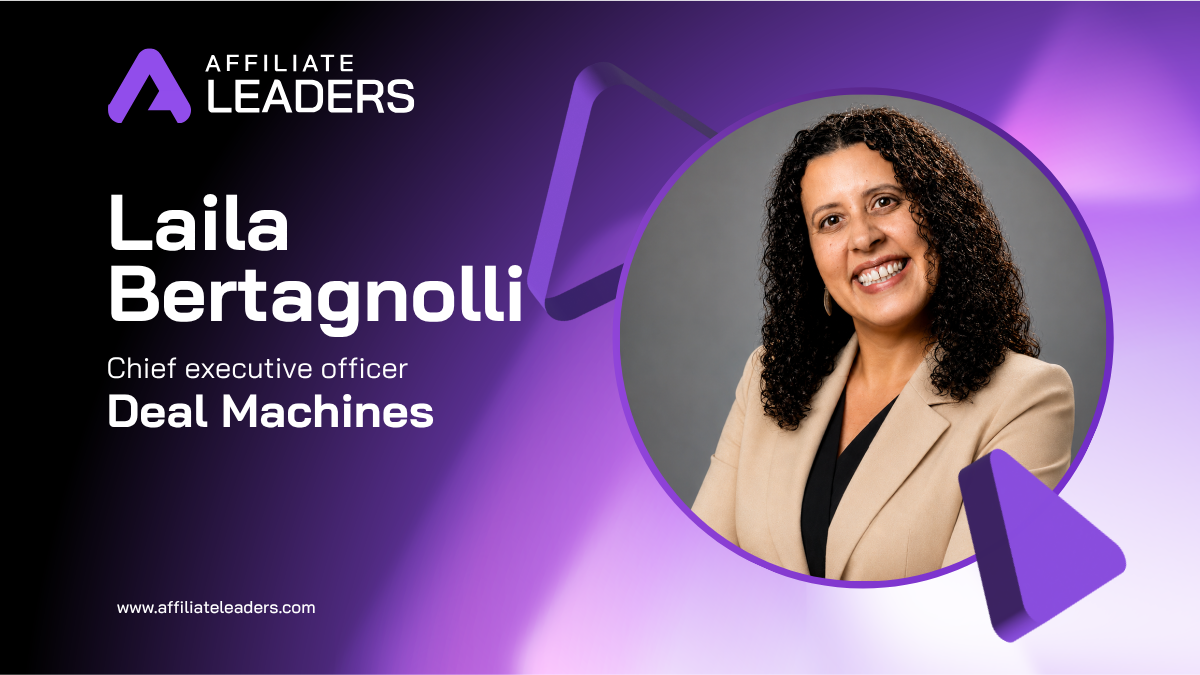
Laila Bertagnolli of Deal Machines gives advice on affiliate marketing compliance and how marketers can navigate an industry where the regulatory and technological goal posts keep changing.
From algorithmic updates on platforms like Google and Meta to the evolving relationship dynamics with operators, the role of an affiliate is changing.
There are so many things now to consider in this current marketing landscape, Laila Bertagnolli, chief executive of Deal Machines, points out, which is why it’s more important than ever for affiliates to become a “reliable source for your users”.
Ahead of her appearance at Affiliate Leaders Summit, Bertagnolli spoke to Affiliate Leaders about why marketers must be tenacious and diversify if they want to survive.
How do you manage the immense technical debt of tracking, updating, and auditing deals across multiple jurisdictions when regulatory goalposts change overnight?
The era of manual updates is over. Integrating efficient systems, together with editors, SEO, content, and commercial teams sharing compliance responsibilities, is what is needed to manage this effectively.
Conversion rate optimisation (CRO) relies heavily on removing friction for users looking for deals. When ad networks and regulators force you to add massive disclosure text, pop-ups, or verification steps, how do you stop compliance from actively killing the user’s intent to convert?
Instead of perceiving disclosure texts, pop-ups, or verification steps as inevitable friction for users, I prefer to see them as part of the user journey, tools that strengthen trust in a brand.
Apart from ensuring that disclosure text is fully contextual and easy to understand, I believe it is crucial to display it where visitors naturally expect to see it. Every market has different expectations and legal requirements, so localisation plays a key role. In my opinion, a market-specific approach is far more effective than a one-size-fits-all compliance strategy.
Have you found that updates from platforms like Google and Meta help affiliates or do they in fact help bad actors, which then has a knock-on effect on legitimate affiliate sites?
Algorithm updates can certainly impact legitimate affiliates negatively while unintentionally benefiting bad actors, as algorithms often struggle to distinguish between the two.
The difference is that bad actors usually have a ‘make money fast’ mindset and strategy, and those tactics are never sustainable in the long term.
My advice to affiliates is to focus on tenacity and diversification rather than creating dependency. Building multiple traffic sources, creating genuine content, and maintaining high compliance standards are the winning strategies for long-term success.
When it comes to traffic safety, do you think platforms like Meta’s Instagram or Facebook and TikTok have a better survival rate relying on diversified organic loops, or is everyone equally vulnerable to account bans right now?
Policies around gambling-related content on platforms like Meta and TikTok are tightening fast, and enforcement is becoming more and more automated. I feel everyone is vulnerable to some degree.
That’s why I strongly believe affiliates should focus on building their own assets rather than relying on third-party platforms only. Owning your traffic, managing a community and your websites is what will give stability.
Operator relationships are the lifeblood of a partnership business. Are you seeing operator partners demand strict compliance guidelines before working with you, or are they reactively slashing partnerships only after a regulator knocks on their door?
At the moment, it really depends on the operator. I am definitely seeing operators introducing KYC procedures for affiliates before entering into a partnership, while also requiring strict compliance standards before launching any marketing campaigns. I do believe this will become the norm across all regulated operators in the near future.
In your experience, what is the single biggest blind spot that causes an otherwise successful affiliate to get blindsided by a compliance penalty?
Compliance is an ongoing process that continuously evolves. It never ends, that’s how I see it. Both existing and newly published content must meet current compliance standards, which is why regular auditing and updating should become part of every affiliate’s routine.
The biggest blind spot I see is focusing only on making new content compliant while forgetting existing content. Staying up to date with regulatory changes, maintaining continuous communication with operators, and implementing recurring compliance checklists are all essential to reducing risks of penalties.
When compliance rules tighten, it often slows down the pipeline for launching new promotions and deals. How do you keep your marketing and content teams agile and creative when they have a compliance editor looking over their shoulders at every single post?
Content teams, SEO and commercial managers should be aligned from day one, working under the same clear guidelines.
Once again, compliance should not be seen as an obstacle but as an integral part of the creative process. When the entire team is working towards the same objective, creativity does not vanish, it becomes smarter instead.
Looking to the future of the affiliate landscape, do you believe that this intense compliance era will eventually level the playing field by weeding out low-quality spammers, or will it just cement a monopoly for the few giant affiliate networks who can afford massive legal departments?
I am confident that the largest affiliate companies will continue to thrive and grow on a global scale as they hold bigger financial and legal resources.
Smaller affiliate businesses will need to remain competitive by focusing on particular niches and targeting individual regulated markets. That is how I naturally see the industry evolving over the next few years.
As for low-quality spammers, I sincerely hope that stronger regulation will reduce their presence and contribute to a healthier, more sustainable environment within the industry.
If you could give the audience at the Affiliate Leaders Summit, one golden rule to future-proof their content against the next wave of ad crackdowns without sacrificing profitability, what would it be?
My golden rule is simple: become a reliable source for your users. A trustworthy source that genuinely helps users make informed decisions will keep succeeding, no matter how the regulatory landscape changes and evolves.
Remember that at the same time, it builds a valuable long-term asset. Investing in high-quality content and in transparency is the winning combination for sustainable success. Chasing shortcuts or exploiting loopholes may deliver short-term earnings, but it is never a wise strategy for building a scalable business.
Finally, how important are events like the Affiliate Leaders Summit in Lisbon at helping educate affiliates in how the marketing landscape is evolving?
Events like the Affiliate Leaders Summit in Lisbon are incredibly important to help affiliates understand how the marketing landscape is evolving. I have been attending SBC events over the years, having the pleasure of listening to several keynote speakers and making new great connections. These events are of great help for affiliates to stay up to date, exchange ideas and gain a better and deeper understanding of the industry’s constant changes.
The Affiliate Leaders Summit is the global home of performance and affiliate marketing. Across three days, affiliates, operators, media companies and technology providers come together to discuss traffic generation, conversion optimisation, SEO, paid media and the commercial strategies shaping the future of affiliate marketing.
Co-located with SBC Summit at Feira Internacional de Lisboa and MEO Arena on 29 September-1 October. Get your tickets here.