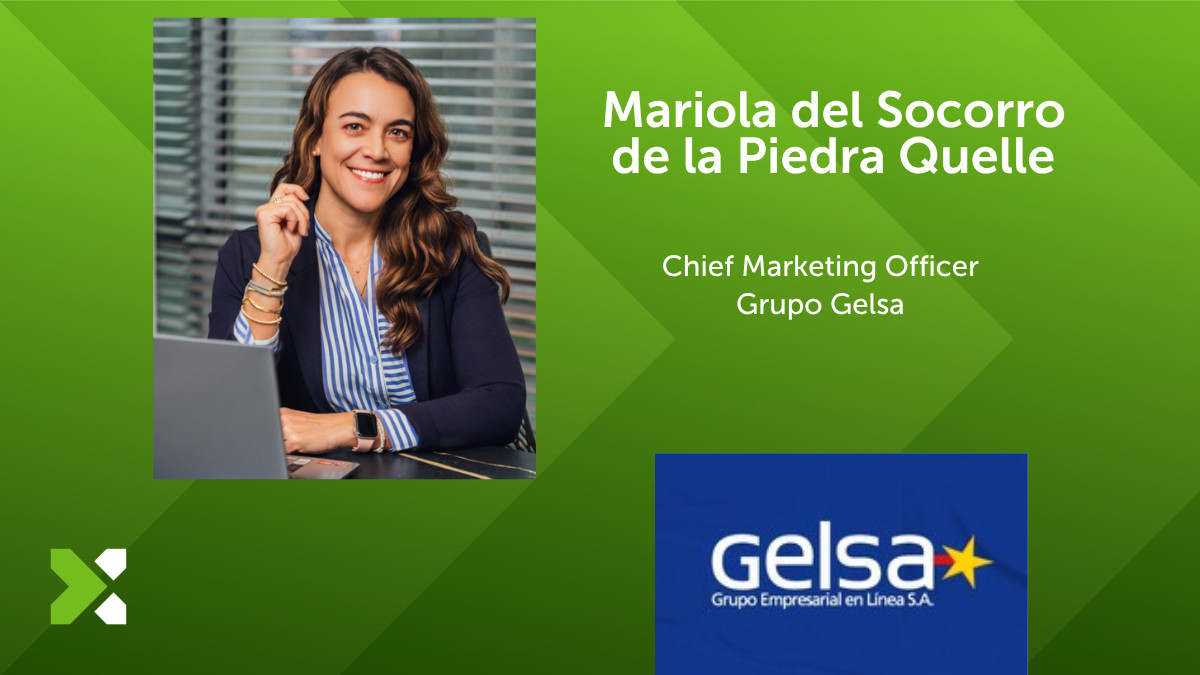
As more companies eye up the opportunities available for expansion across Latin America, Mariola del Socorro de la Piedra Quelle explores some of the factors shaping the region’s adoption of digital payments.
Latin America has attracted a lot of attention from both gaming and payment companies – with markets like Colombia boasting high rates of mobile penetration, it’s primed for those looking to bolster their international footprint.
But with those opportunities come the challenges: localisation, understanding customer behaviours and adapting to differing rates of financial inclusion.
Ahead of her appearance at SBC Summit Americas next week, Payment Expert spoke with Mariola del Socorro de la Piedra Quelle, Chief Marketing Officer of Grupo Gelsa, about challenging the misconceptions around payments in Latin America and why the region is fast becoming a powerhouse for technological innovation.
Read the full interview below.
Latin America has become one of the world’s most dynamic digital economies. From your perspective, what has been the single biggest driver of change in consumer behaviour over the past five years?
I would argue that the biggest driver has been the digitalisation of everyday life through entertainment, information, convenience and mobile-first behaviours, not financial inclusion alone.
Across Latin America, consumers adopted digital habits first through messaging platforms, social media (actually, Colombia ranks at the top of social media consumption in the world!), video content, gaming, delivery apps and e-commerce. Financial products often facilitated those behavioral shifts rather than creating them.
Colombia is a good example.
According to DataReportal 2025, mobile connections represent approximately 147% of the population, yet internet penetration remains around 80%, meaning that having a device does not necessarily translate into full digital access. In fact, nearly a quarter of the population remains offline. That gap reveals an important reality: digital transformation is not simply about connectivity. It is about relevance.
Consumers embrace digital solutions when they help them stay informed, entertained, connected and productive, when it helps “scratch an itch”. For gaming operators, that means we are increasingly competing for attention, engagement and trust, not just transactions.
Companies such as Mercado Pago, Nubank, and Rappi have transformed consumer expectations around payments and financial services. How has that influenced what players now expect from gaming operators?
They have fundamentally changed the benchmark indeed. And I would also include Pix, Nequi and Yape. Today, players expect the same simplicity from a gaming operator that they receive from Mercado Pago, Nubank, Rappi, Nequi or any leading digital platform: instant onboarding, seamless payments, transparency and frictionless mobile experiences.
However, gaming operators face an additional challenge. Making withdrawals easy is important, but if every transaction immediately leaves your ecosystem, you may solve the payment problem while losing engagement, and long-term value creation opportunities.
That is one of the reasons why Grupo Gelsa launched TodoPay in 2025, the first gaming-native digital wallet in Colombia. Our objective was not only to simplify deposits, withdrawals and prize payments, but also to create a more connected ecosystem where customers can interact with gaming products, services, benefits and rewards through a single experience.
So really, at Grupo Gelsa, we are stepping up the experience. Now, the next generation of gaming wallets will not compete on payments alone, they will compete on relevance, retention and high value platforms, and in offering an ecosystem that offers digital-exclusive games and experiences.
The region’s fintech sector has often innovated out of necessity. Are there lessons operators in more mature markets could learn from Latin America’s approach to digital payments and customer experience?
Absolutely! One of the biggest lessons is that innovation is about understanding friction better than anyone else, it´s not always about adding more technology.
Latin America has had to innovate around cash dependence, uneven connectivity, underbanked populations, regulatory complexity and highly diverse consumer realities.
We often speak about Latin America as a single market, but in reality, it is a collection of very different cultures, economic conditions and behaviors. In many cases, there is as much diversity within a country as there is across countries.
As a result, successful fintech and gaming companies in the region have learned to build highly adaptive customer experiences instead of assuming a “one solution fits everyone” approach.
The lesson for mature markets is simple: customer experience should not be designed for the ideal user, it should be designed for the REAL user. And the real user needs to be taught, shown, helped… we haven´t lost that closeness, we embrace it, we invest behind it.
Embedded finance is becoming a major theme across Latin America. How significant do you think this trend could become for the gaming industry over the next few years?
I believe embedded finance could become one of the most important strategic growth drivers for gaming in Latin America, that´s why we decided to trudge the path of having our own wallet.
Gaming already sits at the intersection of entertainment, money movement, loyalty, rewards and daily consumer habits. Embedded finance allows operators to move beyond the transaction and create broader relationships with their players, creating communities, such as our own, Amigos Paga Todo (Paga Todo Friends).
The opportunity is not simply to add a wallet. The opportunity is to build ecosystems where deposits, withdrawals, prize payments, rewards, loyalty programs and everyday financial interactions become part of a connected experience.
For operators, that can increase frequency, improve customer understanding, reduce friction and strengthen long-term engagement. But it must be built responsibly, transparently and within strong regulatory frameworks.
AI, blockchain, open finance and digital wallets are all competing for attention. Which technology do you believe will have the most meaningful impact on operators in Latin America by the end of the decade?
I can´t choose one, they are all connected! I see you and raise you: I would say digital wallets powered by AI and enhanced by open finance.
The wallet is the interface consumers understand. It is where money becomes tangible, accessible and useful. But the real transformation will come from intelligence.
AI will help operators personalise responsibly, detect fraud, understand player behaviour, optimise retention, advise consumers on savings and spending rates, and create more relevant experiences. Open finance will enrich customer understanding and help create more connected financial ecosystems.
The wallet may be the visible layer, but intelligence will be the engine behind the next generation of gaming experiences.
Despite rapid growth, challenges remain around infrastructure, regulation and financial inclusion. Which of these do you see as the biggest obstacle to the next phase of digital transformation?
I believe financial inclusion remains the biggest challenge because it sits at the intersection of infrastructure, regulation, affordability and trust.
Colombia has made remarkable progress, in gaming, it’s a benchmark country. According to the latest Financial Inclusion Report from Superfinanciera in Colombia, approximately 96.3% of adults now have access to at least one financial product. However, access does not always translate into active usage.The challenge is no longer only opening accounts.
The challenge is creating products that people actually use in their daily lives. Industry organisations such as Colombia Fintech have repeatedly highlighted how taxation, transaction costs, lending conditions and regulatory frameworks can either accelerate or slow adoption. Even small amounts of friction can have a significant impact on behaviour, particularly among underserved populations who live on daily wages.
The next phase of transformation will depend on making digital participation not only possible, but practical, affordable and valuable.
In Grupo Gelsa we aim to support these inclusion initiatives through our physical network. Our 2.500 points of sale facilitate this policy, education, trust and transparency, our robust portfolio with over 350 solutions (gaming, payments, bank correspondent, etc.) allow this seamless experience to build credibility around this program.
Our integration with Colombia´s Immediate Payment System, Bre-b, habilitated by Powwi, our financial institution, will enable us as one the largest if not the largest financial network in Bogota & broader Cundinamarca region, securing our compromise with building a more educated and prepared country.
Many global technology firms are increasingly focused on Latin America. How do you see the region’s role evolving within the wider digital economy?
Latin America is no longer simply a market where innovation is deployed. It is increasingly becoming a market where innovation is created, tested and refined.
The region integrates more than 650 million people, strong mobile adoption, accelerating digital payment usage and some of the most complex consumer environments in the world. Between 2021 and 2024 alone, the percentage of consumers using digital wallets for purchases in Latin America increased from 7% to 18%, according to the Inter-American Development Bank (IDB).
At the same time, the region continues to navigate challenges around inclusion, infrastructure and trust. That combination forces companies to create solutions that are practical, resilient and highly adaptable.
If a payments or gaming solution can succeed in Latin America, it is often resilient enough to succeed almost anywhere.
Our case in Grupo Gelsa, we have developed not only the most robust gaming e-commerce of the country, but also a digital-enabling sales channel seeking to generate more jobs, a gaming-native wallet, we are integrating to commercial allies faster, we are offering a variety of solutions relevant to gaming audiences, facilitating money flow across categories… the options are endless.
You’ll be discussing these themes at SBC Americas. What is the one misconception about Latin America’s technology ecosystem that you would most like to challenge?
The biggest misconception is that Latin America is behind. In reality, Latin America is showing Marketing at its best: solving problems that many mature markets never had to solve.
We are building digital ecosystems in environments where connectivity, financial inclusion, regulation, infrastructure and consumer behavior are evolving simultaneously. That complexity forces innovation.
The most successful companies in the region are not simply importing global models. They are adapting them to local realities, cultural nuances and highly diverse consumer expectations.
The question is no longer what Latin America can learn from the rest of the world. Increasingly, it is what the rest of the world can learn from Latin America.
And probably one of the biggest misconceptions that we are aiming to tackle is that “gaming is bad”… this industry is one the biggest drivers of the entertainment segment, it generates thousands of formal jobs, and it supports government crucial social programs, in Colombia for example, Gelsa alone has contributed over $300m dollars to the health system in its 20 years history.
Source: Payment Expert