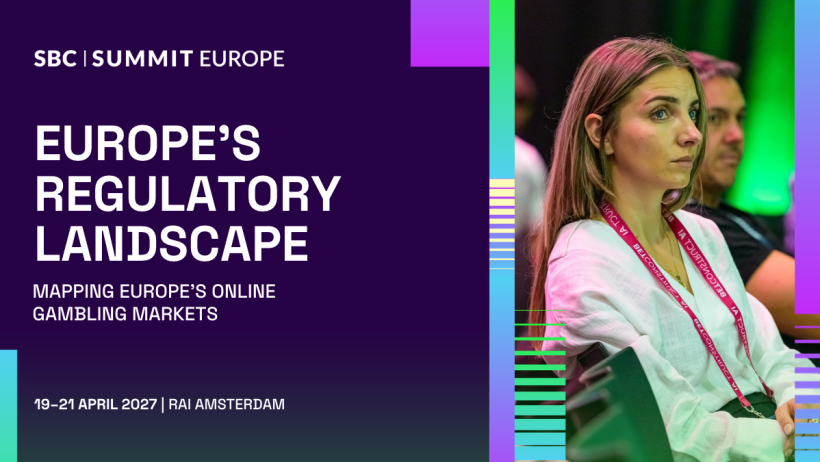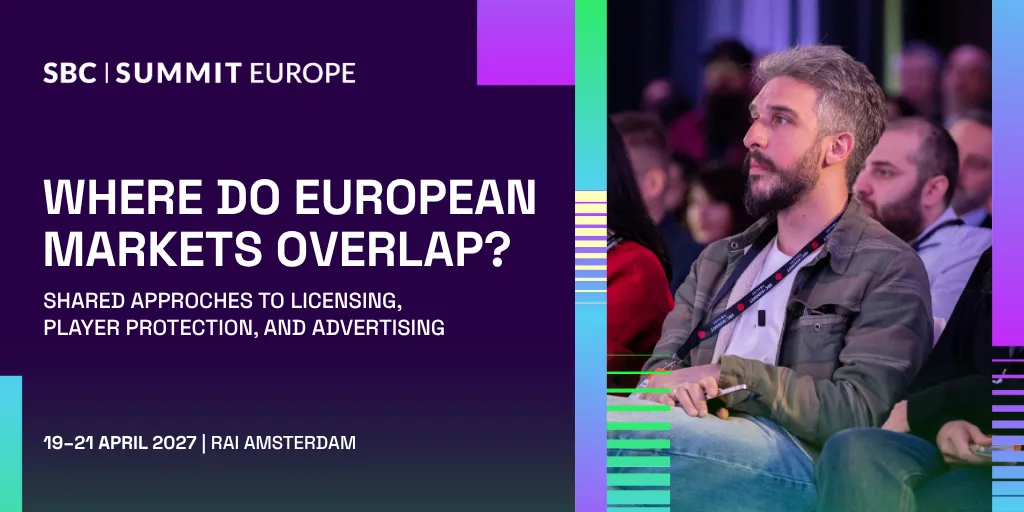
SBC Summit Europe | 19-21 April 2027 | RAI Amsterdam
Europe’s gambling landscape is fragmented at best, with regulations varying significantly from one market to another.
But that does not mean these markets have nothing in common.
Each time an operator launches in a new European jurisdiction, it is not starting from scratch.
Whilst specific licensing fees, payment preferences and advertising rules may differ from country to country, much of the expertise, infrastructure, processes and safer gambling systems can often be adapted and reused across multiple markets.
Ahead of SBC Summit Europe, taking place at RAI Amsterdam from 19–21 April, we’ll look at where Europe’s regulated markets already overlap in practice, and why those similarities increasingly make the continent one interconnected business for operators.
Table of Contents
Different Licences, Familiar Requirements
There is no singular European gambling licence, meaning operators wanting to operate across multiple jurisdictions generally need to obtain the relevant authorisations for each market. Each application can involve different application processes, fees, and product requirements.
The good news for operators, though, is that much of the underlying requirements to get licensed are similar.
In Great Britain, the Gambling Commission assesses applicants on areas including ownership, finances, integrity, competence and criminality. Remote operators must also provide information covering their business plan, funding, ownership structure, technical systems and regulatory policies.
Germany uses a different framework, but many of the underlying requirements overlap. The GGL requires applicants to demonstrate their reliability and financial capability, alongside submitting plans covering areas including economic viability, IT security, payment processing, social responsibility and anti-money laundering.
Malta follows a similar pattern. The MGA assesses whether applicants are fit and proper, financially viable and operationally capable, while its licensing checklist covers areas including company structure, business plans, technical systems, KYC and AML procedures and responsible gaming.
Across these markets, licensing frameworks repeatedly assess many of the same areas, including financial suitability, ownership, AML controls, technical systems and responsible gambling. That works in established operators’ favour: businesses that already have the teams, infrastructure and processes to meet those requirements can adapt them to a new regulator rather than build everything from scratch.
Entain illustrates that model at scale. The group holds regulatory licences across numerous European jurisdictions, including Great Britain, Germany, Italy, Denmark, the Netherlands, Spain and Sweden.
Its brands may face different national rulebooks, but the expertise required to understand those rules, prepare applications and maintain compliance can be shared across the wider business.
That is one of the practical ways Europe’s separately regulated markets already overlap: the licences remain national, but the capabilities required to obtain and operate under them increasingly cross borders.
Local Payment Preferences, Shared Infrastructure
Payments are a good example of how European gambling markets can remain local for the customer while being interconnected for operators.
Player preferences vary considerably. In the Netherlands, e-payment solutions including digital wallets and services such as iDEAL accounted for 76% of online payments in 2024, compared with 46% in Germany and 43% in the UK, while cards remained the most commonly used online payment method across much of the rest of the euro area.
Operators therefore have to localise the payment methods they offer. A Dutch customer may expect to see iDEAL, while players in another market may prefer cards, bank transfers or other local options.
But the payment method visible to the customer is only the front end.
Behind it, operators can increasingly use the same payment providers, fraud controls, KYC systems and banking infrastructure across several jurisdictions. The Single Euro Payments Area, for example, allows euro payments to operate under common standards across European markets, while cross-border payment providers can support multiple local methods through the same underlying infrastructure.
That shared infrastructure can make expansion into new markets more manageable. Operators may need to add or remove individual payment methods to reflect local preferences, but the wider systems used to process transactions, verify customers and manage risk can often remain in place.
For operators, the result is a familiar pattern: the payment experience may look different from one country to another, but much of the infrastructure supporting it is increasingly shared across Europe.
Different Advertising Rules, Shared Approach
Advertising is one of the clearest examples of regulatory fragmentation across Europe, with it being one of the most politicised aspects of the industry.
Italy, for example, decided to take a strict approach in 2018 with the passing of its Dignity Decree, which introduced a broad ban on gambling advertising across television, radio, print, social media and the internet, with certain limited exceptions. The ban was subsequently extended to sponsorships from January 2019.
The Netherlands meanwhile took a more targeted approach, with rules requiring operators to ensure that at least 95% of the audience reached is aged 24 or over, prohibiting the use of role models such as influencers and professional athletes, and banning all gambling sponsorships from July 2025.
Britain’s approach is more flexible by comparison. Gambling advertising remains permitted across a wide range of media, such as TV and radio, but licensed operators must comply with the CAP and BCAP advertising codes and ensure their marketing is socially responsible.
These rules place particular emphasis on protecting younger audiences: under-25s generally cannot play a significant role in gambling advertising, while adverts must not feature people or characters likely to have strong appeal to under-18s. Operators must also ensure promotions are not misleading and that significant terms and conditions are presented clearly to consumers.
For an operator active across all three markets, the same campaign therefore cannot simply be translated and rolled out across Europe. The channels available, audiences that can be targeted and even the people who can appear in advertising may change from one jurisdiction to another.
But there is still an important operational overlap.
Operators working across several markets need teams capable of interpreting advertising rules, approving creative, checking audience targeting and ensuring agencies and affiliates remain compliant. Those same legal, compliance and marketing functions can support multiple jurisdictions, adapting campaigns to local restrictions without rebuilding the process each time.
The practical overlap is therefore not in the advertising rules themselves, but in the capability needed to manage them.
For operators, Europe may require different campaigns, but understanding how to translate national restrictions into compliant marketing is increasingly a cross-market function.
Different Safer Gambling Rules, Shared Responsibilities
Safer gambling is another area where national rules differ, but the operational demands on operators increasingly overlap.
The exact tools vary. In the Netherlands, operators must check every player against Cruks, the national self-exclusion register, before allowing them to gamble. In Great Britain, self-exclusion is initiated by the player through GAMSTOP, but licensed online gambling operators are covered by the relevant requirements are required to participate in the scheme and block registered customers.
The process is therefore different, but the objective is similar: giving operators a central system for identifying players who should not be allowed to gamble.
Beyond self-exclusion, regulators are also placing greater responsibility on operators to identify risky behaviour and intervene when necessary.
Regulators increasingly expect operators to monitor customer behaviour, identify signs of harm and intervene when necessary. In Great Britain, remote operators must have systems capable of monitoring factors including customer spend, patterns of spend, time spent gambling and behavioural indicators.
The Netherlands places a similar responsibility on operators. Licensed online gambling companies are required to monitor and analyse player behaviour and intervene where gambling appears to be becoming excessive or problematic.
The thresholds, databases and intervention requirements may differ from one jurisdiction to another, but the underlying need to track the behaviour of players remains the same.
An operator active across Europe needs systems that can monitor customer activity, flag potential risk, support interventions and record how those interventions were handled. The local rules determine when and how those systems are used, but much of the technology, expertise and operational process behind them can support several markets.
That creates another practical overlap between Europe’s regulated markets: the safer gambling framework may be national, but the capability required to deliver it can increasingly be built across the wider business.
Final Thoughts
While every jurisdiction will naturally have its own rules, with some stricter than others, for operators, these jurisdictions share a lot of commonality.
The licences may be national, payment preferences local and advertising restrictions different, but much of the underlying infrastructure and expertise can be reused across markets.
That is what makes Europe more interconnected than its regulatory map might suggest. Operators are not entering completely separate businesses every time they expand into a new jurisdiction, but are instead adapting the same core capabilities to different national requirements.
These cross-market similarities will be the backbone of SBC Summit Europe, where operators, regulators and suppliers can compare how different jurisdictions are approaching the same commercial and regulatory challenges.
FAQs
What is SBC Summit Europe?
SBC Summit Europe is the Home of European iGaming, with regulated markets at its heart. It is the annual meeting place for the people leading, regulating and building European gaming.
When and where does it take place?
19-21 April 2027 at RAI Amsterdam, the Netherlands.
Who will be there?
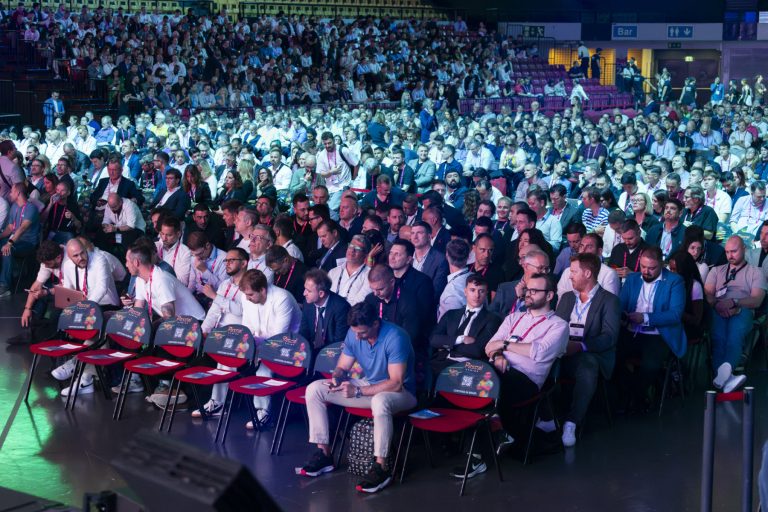
Around 8,000 attendees are expected, including more than 3,000 licensed operator representatives. They will be joined by regulators, policymakers, industry associations, legal experts, suppliers, affiliates, investors and media. SBC Summit Europe attendee overview.
What is the main focus of SBC Summit Europe?
SBC Summit Europe is where the people running, regulating and building licensed markets finally share a room. Regulators and policymakers join the conversation directly, alongside licensed operators, who sit at the heart of the event with more than 3,000 operator representatives expected. Networking is as much a priority as education, so the programme is built to turn insight into conversations, relationships and commercial outcomes that would be hard to arrange any other way. Partnerships with IAGR and IMGL, alongside relationships with regulatory bodies and industry associations, are bringing gaming authority representatives from across Europe to Amsterdam.
What topics will be covered?
Channelisation and black-market competition, taxation, advertising restrictions, player protection and affordability, licensing and compliance, and the impact of new technology and AI. The programme will also cover compliance technology, payments, sports betting platforms and data, casino, marketing and changing player behaviour. Check the SBC Summit conference agenda.
Is the event focused on one market or on Europe as a whole?
Both. Dedicated sessions explore individual jurisdictions in detail, while broader discussions look at the trends and lessons that apply across borders.
How can I get a pass?
Operators, regulators, and qualifying affiliates can apply for complimentary passes. For everyone else, registration will open soon. For now, register your interest for SBC Summit Europe.