Table of Contents
Take a look at the SBC Summit Europe conference agenda, and you’ll notice a recurring theme: channelisation.
From the UK and France to Poland, Denmark, Germany and Romania, the question of how to keep players within the regulated gambling sector sits at the heart of discussions across Europe.
The objective is clear. The path to achieving it is anything but.
Across Europe, regulators are pursuing the same ambition, yet their approaches to taxation, advertising restrictions, player protection and market accessibility vary considerably. So do their results.
What makes a regulated market attractive enough to retain players? Where is the balance between protecting consumers and maintaining a competitive legal platform? And can measures designed to make gambling safer inadvertently push players towards unlicensed alternatives?
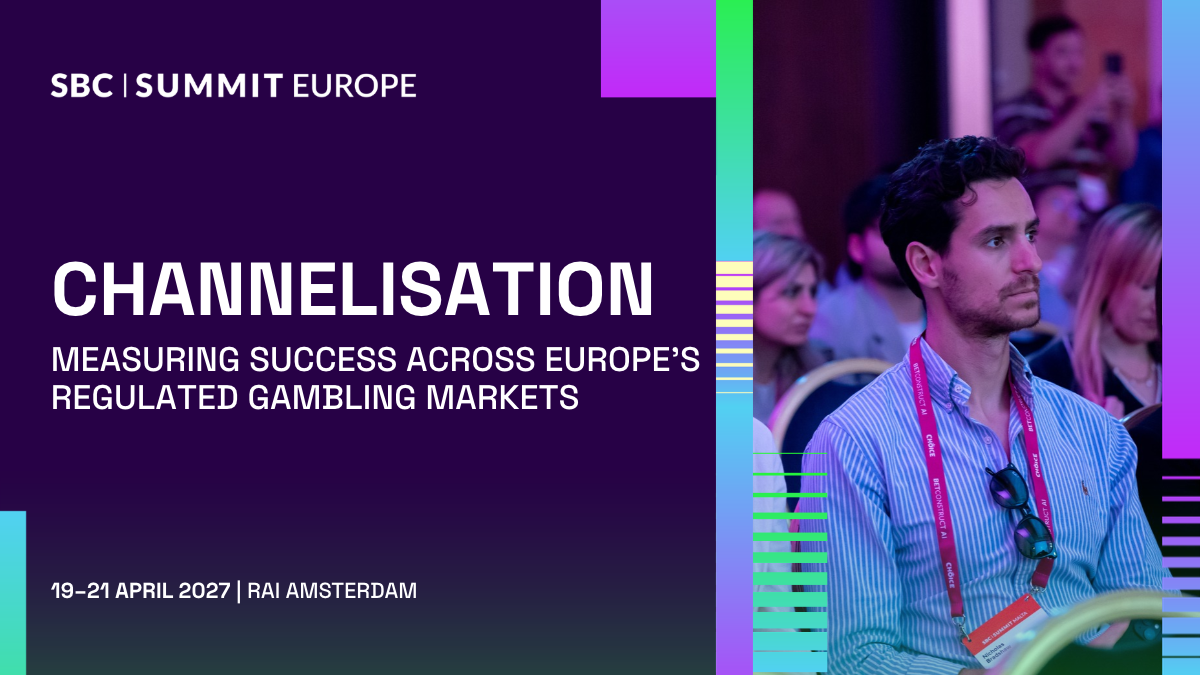
Ahead of SBC Summit Europe 2027, taking place from 19–21 April at RAI Amsterdam, we’re exploring what channelisation means in practice, how different European markets are approaching it, and what separates regulatory ambition from measurable success.
So, what is Channelisation?
Put simply, channelisation measures how much gambling activity takes place with licensed operators within a regulated market, rather than with unlicensed or offshore alternatives.
For example:
- 100% channelisation: All gambling takes place within the regulated market.
- 70% channelisation: 30% of gambling remains with unlicensed operators.
For regulators, the objective is straightforward: achieve the highest possible channelisation rate and keep gambling activity within the regulated sector, an objective that will sit at the heart of many discussions across SBC Summit Europe’s conference programme.
Channelisation Across Europe: A Snapshot
A look at some of Europe’s regulated gambling markets reveals a wide range of reported channelisation rates.
Please Note: Figures are based on different reporting periods and measurement methods, so they should not be interpreted as a direct ranking of European markets.
- Netherlands: 91% (Players exclusively using licensed operators, H2 2025)
- Sweden: 84% (Regulator’s overall channelisation estimate, 2025)
- Denmark: 91.5% (Estimated licensed share of online gambling expenditure, 2024)
- Germany: 77.03% (Estimated licensed online gambling share, 2024)
- Great Britain: 92.3% (Industry-estimated GGY-based channelisation, 2025)
At first glance, these percentages offer an interesting picture of channelisation across Europe.
But here’s the tricky part: not every country measures channelisation or tackles channelisation in the same way, meaning a higher percentage doesn’t necessarily indicate a more successful regulated market.
But more on that later. First, it’s important to understand why regulators are so determined to reach that all-important 100% channelisation rate.
What’s Driving Europe’s Push for Higher Channelisation?
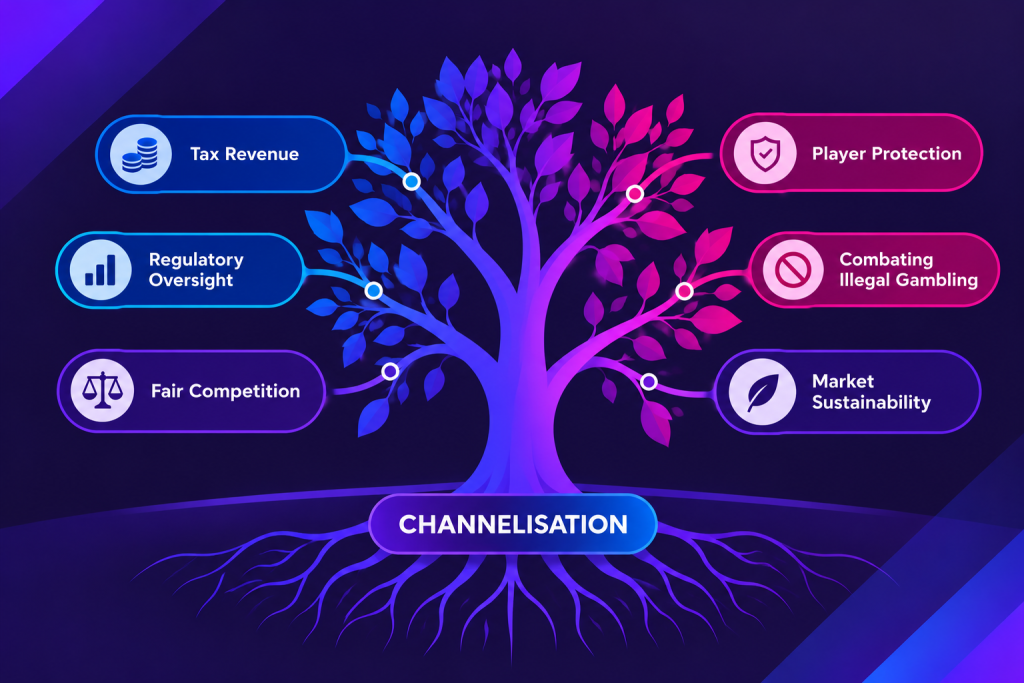
On the surface, the importance of channelisation is clear. It keeps gambling activity within the regulated market. But scratch at the surface a little more and you’ll find its importance extends far beyond that initial idea.
Think of channelisation as a tree. From this tree grow several interconnected branches, each representing a different legal, regulatory or financial objective.
Here, each branch strengthens the stability of the overall tree, whilst the tree itself allows each brand to continue growing.
So, what exactly are those branches?
- Player Protection: Higher channelisation means more players benefit from the safeguards required of licensed operators, including responsible gambling tools, self-exclusion schemes, financial protection and dispute processes.
- Regulatory Oversight: Licensed operators must comply with reporting, monitoring and auditing requirements, giving regulators greater visibility over gambling activity and more opportunities to identify and address potential risks.
- Tax Revenue: Keeping gambling activity within the regulated market ensures more revenue is subject to taxation, generating funds that governments can reinvest into public services, regulatory enforcement and gambling harm prevention.
- Fair Competition: Higher channelisation reduces the competitive advantage enjoyed by unlicensed operators, who may avoid the taxes, licensing costs and consumer protection obligations imposed on regulated businesses.
- Combating Illegal Gambling: Higher channelisation reduces the share of gambling activity captured by unlicensed operators, limiting their commercial opportunities.
- Market Sustainability: By keeping more gambling activity within the licensed sector, strong channelisation can support operator viability, encourage investment and create conditions for continued innovation and competition.
Together, these benefits explain why channelisation has become such an important consideration for regulators across Europe. Channelisation helps regulators achieve protection and accountability across the market.
However, achieving it is another matter entirely.
Why achieving high channelisation is easier said than done
Here’s where things get complicated.
Ironically, many of the very factors that make high channelisation so important are also the factors making 100% channelisation so difficult to achieve.
Consider the following challenges facing European regulators:
- Taxation: High gambling taxes increase accountability and public funding, but can also make a market less attractive by increasing licensed operator costs. In the Netherlands, the gambling tax rate increased to 37.8% in January 2026, raising questions about the financial sustainability of regulated operators in the market.
- Advertising Restrictions: Limits on gambling advertising can help protect vulnerable players, but can also make it harder for licensed operators to attract customers away from illegal sites. In Italy, the Dignity Decree introduced a broad advertising ban in 2018, which the country’s gambling regulator has argued may have inadvertently strengthened the black market.
- Player Protection Requirements: Affordability checks, deposit limits and verification processes protect consumers’ finances and well-being. But in Sweden, 23% of surveyed unlicensed-site users cited being blocked from licensed operators through the national self-exclusion scheme as a reason for using illegal sites.
- Product Availability: Restrictions on gambling products can leave consumer demand that unlicensed operators are willing to serve. In France, online casino games remain prohibited, while an industry study found that 5.4 million consumers had visited illegal gambling sites, an increase of 35% over two years.
For European regulators, this presents a challenge. Channelisation’s ultimate goal is to help protect players with a number of regulated benefits. But if those benefits are also making a market less attractive to both operators and players, you could in fact push players and operators to enter the black market.
How Do We Measure Successful Channelisation?
A higher channelisation rate might suggest a more successful regulated market. But there’s a catch: not every European regulator measures channelisation in the same way.
Some focus on the number of players using licensed operators, while others examine how much gambling expenditure remains within the regulated sector.
And even when measuring the same thing, different methodologies can produce very different results.
The Netherlands, Denmark and Sweden offer three interesting examples.
The Netherlands: Does high player channelisation mean success?
In H2 2025, only several years after market regulation, an estimated 91% of Dutch online gamblers were using licensed operators exclusively.
However, when channelisation was measured by gambling losses rather than player numbers, the estimated channelisation rate was just 53%.
In other words, despite the overwhelming majority of players gambling exclusively with licensed operators, an estimated 47% of gambling losses were still going to unlicensed operators.
This exposes an important limitation. A high player-based channelisation rate doesn’t necessarily mean an equally high proportion of gambling expenditure is remaining within the regulated sector.
This raises an important question: is player-based channelisation alone enough to measure regulatory success, or should gambling expenditure always be considered?
Denmark: Is expenditure the correct way to measure success?
Denmark takes a different approach, focusing on expenditure-based channelisation, which measures the proportion of estimated online gambling losses captured by licensed operators.
In 2024, that figure reached 91.5%, meaning the overwhelming majority of estimated online gambling losses remained within the regulated sector.
This approach offers valuable insight into the regulated sector’s ability to compete financially with unlicensed operators. However, it also highlights an important distinction: capturing the majority of gambling expenditure is not necessarily the same as capturing the majority of players.
A relatively small number of players spending heavily with unlicensed operators could have a disproportionate impact on expenditure-based channelisation, while a larger number of players gambling occasionally outside the regulated sector might have a comparatively limited effect.
Both measures therefore offer different perspectives on the same challenge, making it important to understand what channelisation figures actually represent before using them to assess regulatory success.
Sweden: What exactly are we measuring?
According to gambling regulator Spelinspektionen, Sweden’s estimated channelisation rate stood at 84% in 2025, down from 85% in 2024.
However, the methods used to calculate that figure produced different results. Consumer surveys estimated channelisation at 89%, while internet traffic and turnover analysis suggested 78%.
The discrepancy highlights one of the fundamental challenges of measuring channelisation: regulators have reliable information about licensed operators, but must estimate much of the activity taking place outside the regulated market.
Consumer surveys depend on players accurately reporting their gambling behaviour, while internet traffic analysis relies on estimates of activity at unlicensed websites.
Neither method offers a complete picture.
As a result, the same market can produce significantly different channelisation rates depending on how the data is collected and interpreted. This raises an important question for regulators across Europe: how can markets meaningfully compare their success if the methods used to measure it are not consistent?
How do you define success?
The Netherlands, Denmark and Sweden demonstrate that no single channelisation figure tells the whole story.
Player-based measurements reveal how many consumers are using licensed operators, while expenditure-based measurements show how much gambling revenue remains within the regulated sector. Different estimation methods can also produce significantly different results.
Ultimately, successful channelisation is about more than achieving the highest percentage. It’s about understanding what that percentage measures, how it is calculated and whether it reflects the wider objectives of a regulated market.
Channelisation on the Agenda at SBC Summit Europe 2027
With European regulators continuing to refine their approaches to taxation, player protection and market competitiveness, channelisation will be a recurring theme across the SBC Summit Europe 2027 conference programme.
Sessions exploring these challenges include:
- UK: The New Economics of the UK Gambling Market: Tax, Regulation, Player Protection and Maintaining Profitability
- Finland: Finland Unlocked: From Monopoly to Multi-Licence Market
- Germany: Product vs Channelisation: Can the GlüStV Unlock the Legal Market?
- France: The Missing Piece of the Market: Where Does French Online Gambling Go Next?
- Netherlands: Winning Back the Market: The Dutch CEO Debate
- Romania: CEE’s Online Gambling Powerhouse: Growth, Regulation and the Competitive Landscape
- Poland: Can It Reach Its Potential Given Taxation, Channelisation and Offshore Competition?
Together, these discussions will explore how different European jurisdictions are balancing regulatory objectives with the commercial realities of operating in a competitive gambling environment.
One Goal, Different Approaches
Across Europe, regulators may differ on taxation, advertising, player protection and even how channelisation itself is measured.
But the objective remains the same: keep as much gambling activity as possible within the regulated sector.
And achieving that goal requires more than simply chasing the highest percentage. It means creating a regulated environment that protects consumers, remains competitive and gives players compelling reasons to choose licensed operators.
That’s why channelisation will remain a central topic when industry leaders and regulators gather at SBC Summit Europe 2027, taking place from 19–21 April at RAI Amsterdam.
Frequently Asked Questions (FAQs)
What is SBC Summit Europe?
SBC Summit Europe is the Home of European iGaming, with regulated markets at its heart. It is the annual meeting place for the people leading, regulating and building European gaming.
When and where does it take place?
19-21 April 2027 at RAI Amsterdam, the Netherlands.
Who will be there?
Around 8,000 attendees are expected, including more than 3,000 licensed operator representatives. They will be joined by regulators, policymakers, industry associations, legal experts, suppliers, affiliates, investors and media. SBC Summit Europe attendee overview.
What is the main focus of SBC Summit Europe?
SBC Summit Europe is where the people running, regulating and building licensed markets finally share a room. Regulators and policymakers join the conversation directly, alongside licensed operators, who sit at the heart of the event with more than 3,000 operator representatives expected. Networking is as much a priority as education, so the programme is built to turn insight into conversations, relationships and commercial outcomes that would be hard to arrange any other way. Partnerships with IAGR and IMGL, alongside relationships with regulatory bodies and industry associations, are bringing gaming authority representatives from across Europe to Amsterdam.
What topics will be covered?
Channelisation and black-market competition, taxation, advertising restrictions, player protection and affordability, licensing and compliance, and the impact of new technology and AI. The programme will also cover compliance technology, payments, sports betting platforms and data, casino, marketing and changing player behaviour. Check the SBC Summit conference agenda.
Is the event focused on one market or on Europe as a whole?
Both. Dedicated sessions explore individual jurisdictions in detail, while broader discussions look at the trends and lessons that apply across borders.
How can I get a pass?
Operators, regulators, and qualifying affiliates can apply for complimentary passes. For everyone else, registration will open soon. For now, register your interest for SBC Summit Europe.