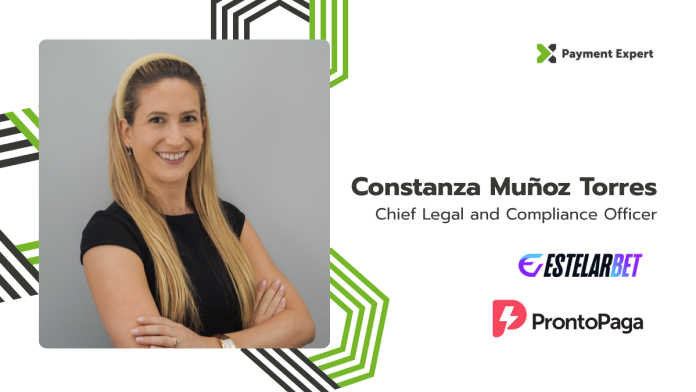
Ahead of SBC Summit 2025, Constanza Muñoz Torres, Head of Regulation and Public Policy at Minka, offered valuable insights into instant payment regulation, cross-border friction, and the steps needed to deliver faster, more secure financial transfers across Latin America.
Constanza Muñoz Torres has a rare dual vantage point. As Chief Legal and Compliance Officer at EstelarBet and Chief Legal Officer at ProntoPaga, she sits at the intersection of two fast-evolving sectors: digital gaming and fintech.
With a remit that spans regulatory oversight in both entertainment and payments, her perspective is grounded in day-to-day operational realities, but focused on long-term strategic alignment.
Ahead of SBC Summit Lisbon, where one of the topics on the agenda will be ‘Payments 2030’, Muñoz Torres spoke to Payment Expert about the innovations shaping Latin America’s payments infrastructure and the critical role of private sector leadership in developing forward-thinking regulatory frameworks.
Technology is already reshaping the future
Asked to identify the most transformative technology shaping payments by 2030, Muñoz Torres points out that the future is already arriving. Developments like Brazil’s Pix, Colombia’s Bre-B and India’s UPI have accelerated the shift toward instant, low-cost, and highly secure digital transactions. But for her, the true disruptor lies in the concept of borderless wallets.
“The most transformative technology on the horizon is the rise of truly interoperable wallets,” she says.
“I’m talking about wallets with no geographic boundaries, no reliance on legacy card rails, and no hidden costs due to currency conversion. This level of interoperability has the power to completely reshape how we move money, not just within a country, but across the globe.”
Beyond wallets, Muñoz Torres also highlights artificial intelligence as a foundation for change.
“I strongly believe AI will also play a critical role—particularly in areas like fraud detection, automation, personalization, and operational efficiency. The impact of AI is already visible, and by 2030, it will likely be foundational to how the entire financial ecosystem operates.”
Regulatory pace lags innovation
Despite the promise of new technologies, Muñoz Torres is candid about the hurdles. “Regulation in Latin America is moving significantly slower than technological innovation,” she says. “In many cases, those drafting the regulations lack deep knowledge of the market, which often leads to unnecessary entry barriers for players who could genuinely add value to the ecosystem.”
Rather than wait for legislation to catch up, she believes in adopting a proactive stance. “We adopt best practices by looking to markets that are moving much faster, setting higher standards internally rather than reacting to external pressures,” she explains. “The key lies in having a preventive rather than reactive approach.”
Muñoz Torres is also an active participant in industry forums, seeing this engagement as essential for long-term trust. “I regularly participate in compliance-focused panels, I’m a member of the Legislative Support Committee at the Santiago Chamber of Commerce, and I’m involved in initiatives led by women in Fintech across the region.”
Biometrics and instant payments: Compliance in real time
The growth of instant payments and open banking has raised the bar for real-time compliance. But Muñoz Torres sees biometric authentication as an essential part of the solution rather than a future possibility.
“Biometric authentication isn’t just the future—it’s already a MUST,” she says. “At EstelarBet, for example, we’ve seen a significant reduction in chargeback rates thanks to biometric ID verification. By extracting user data directly from official identity documents, we’re able to ensure that users can only use payment methods that match their verified identity—closing a major loophole for fraud.”
Her approach to compliance is detailed and practical. She lists key red flags operators should monitor in an instant payments environment, from identity theft and mismatched payment methods to bonus abuse and anomalous transaction patterns.
“Ultimately, instant payments and open banking require real-time compliance capabilities, including robust fraud detection systems, strong customer authentication, and a constant dialogue between compliance, legal, tech, and product teams,” she notes.
Cautious optimism on digital currencies
With digital assets gaining legitimacy worldwide, Muñoz Torres sees strong potential in the gaming and entertainment sectors, provided that operators take a measured approach.
“Digital currencies are no longer just a possibility, they’re both the present and the future,” she says. “But adoption should never be automatic. It’s essential to take a thoughtful, case-by-case approach: analyzing what we truly gain by integrating these tools, and understanding that the benefits may be significant for some operators, while limited for others.”
As always, the balance between innovation and user protection remains central. “With the right controls in place, digital currencies can become a powerful asset, not just a trend,” she says.
The private sector must co-author future frameworks
Muñoz Torres believes that public-private collaboration is not a nice-to-have, but a necessity.
“It is the private sector that truly understands how these ecosystems function in practice,” she argues. “That’s why industry leaders must go beyond mere compliance and take on the role of educating, informing, and constructively engaging with the public sector.”
She advocates for participation in consultations, working groups, and open dialogue that fosters trust and realism in rulemaking.
“If we want regulation that fosters innovation rather than stifling it, the private sector must act as both a strategic partner and a responsible stakeholder—helping shape frameworks that are realistic, forward-thinking, and grounded in operational reality.”
Transparency, security, and trust in the age of automation
As payments become more automated and AI-driven, Muñoz Torres returns to a simple but powerful principle: trust.
“Consumers need to feel that their data is safe, that their transactions are being handled responsibly, and that they understand how the systems around them work,” she says. “Clear communication, ethical data practices, and user experiences designed with transparency at their core” are non-negotiable.
“Innovation is exciting—but responsible innovation is what truly drives long-term adoption.”
SBC Summit will take place from 16–18 September at the Feira Internacional de Lisboa and MEO Arena, bringing together 30,000 industry stakeholders for an unmissable three-day experience.
Looking to attend? Here’s how:
- Secure your place with a VIP Event Pass – Enjoy full access to all conference sessions, the exhibition floor, exclusive networking events, and complimentary food and drink throughout the summit.
- Bringing the team? Take advantage of our Group Pass Discount — purchase three or more VIP Event Passes and pay just €400 per ticket (saving €200 off the standard price).
- Operator or affiliate? You may be eligible for a complimentary VIP Event Pass, which includes full access to the exhibition, conference, and exclusive networking events. Apply now to reserve your spot.
Expo+ Pass: Gain access to the full exhibition floor and all conference sessions across the three days. This does not include access to our exclusive VIP evening networking events.