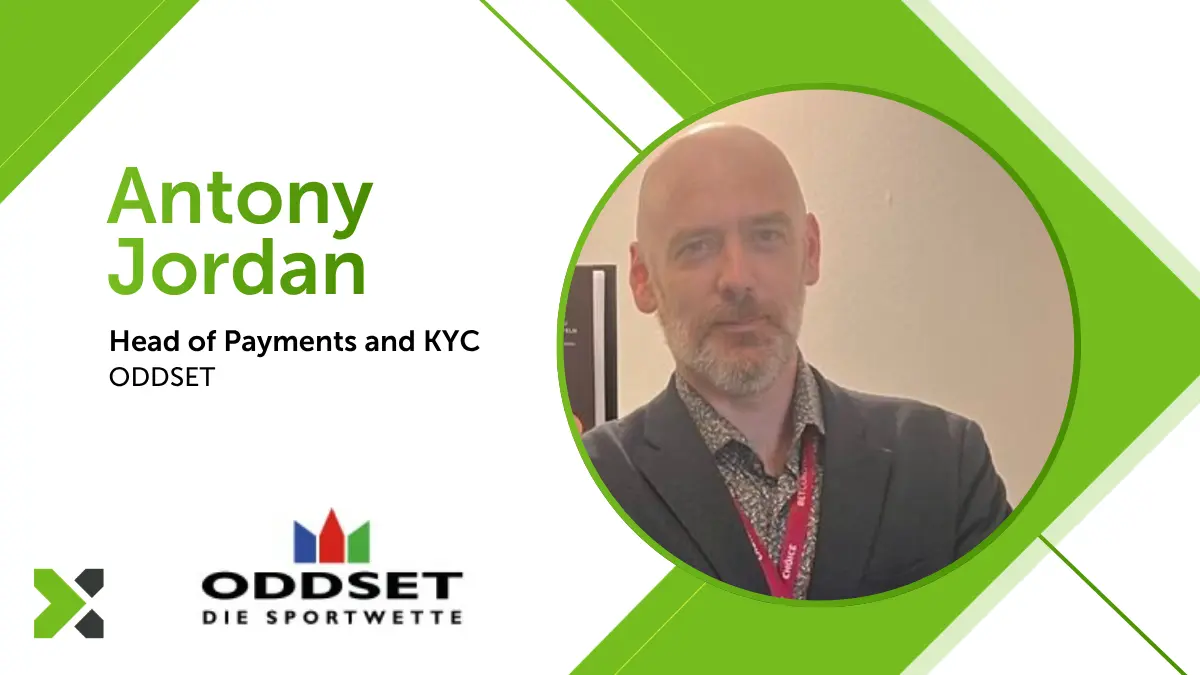
ODDSET’s Head of Payments and KYC on continuous monitoring, biometric friction, KYB’s lag and preparing for AMLA’s incoming standardisation
KYC has long been treated as a one-time hurdle at onboarding, cleared once and rarely revisited.
Antony Jordan, Head of Payments and KYC at German sports betting operator ODDSET, makes the case that the model is already obsolete – driven by the EU‘s incoming Anti-Money Laundering Regulation (AMLR), the new Anti-Money Laundering Authority (AMLA), and a shift toward ‘eIDAS first’ verification built around digital wallets rather than documents.
Ahead of his appearance at SBC Summit 2026 in Lisbon, Payment Expert spoke to Jordan about where operators are least prepared for the reforms, how Oddset weighs verification friction against compliance, the volatility of sanctions and PEP lists, and why KYB still trails consumer-facing KYC.
For more details on your chance to attend SBC Summit 2026, and hear from Antony Jordan in person, follow the link HERE for more details.
Read the full interview below.
KYC has traditionally been a compliance checkbox – how far has Oddset moved toward treating it as a continuous risk and trust framework rather than a one-time onboarding step?
ODDSET operates with a ‘Compliance First’ mindset and this, combined with a sole focus on the regulated online sports betting market in Germany, has seen us embrace the area of customer verification so that the traditional handling of KYC as just a compliance checkbox is very much avoided.
The framework within which we operate requires that we conduct regular, ongoing checks with customers. ODDSET builds on this with ongoing, frictionless monitoring to build trust and security, while ensuring that verification checks are only requested at the appropriate times.
When we are required to complete additional KYC checks we ensure that the range of options provides solutions that cater the entire range of our customer base so that they want to engage in these processes in a way that provides with them satisfaction from a good and personalised user experience.
AMLA oversight and the incoming EU AML reforms will raise the bar on standardisation across member states. Where do you think operators are least prepared for what’s coming?
One of the biggest changes that the new EU AMLR framework will bring to the table is that operators adopt an ‘eIDAS first’ format for operation in the areas of customer verification.
The industry has long relied on documentation for fulfilling KYC requirements, either via images and PDFs or through a third-party provider, and the requirement to ensure that digital wallets take centre stage – alongside a relatively tight deadline for implementation, a new way of operating, and assisting in end-user adoption – will certainly require the preparation work to be well underway.
Biometric liveness and automated risk scoring are becoming more common, but so is player frustration with friction at onboarding. How do you strike that balance at Oddset?
As mentioned previously, ODDSET operates solely in the regulated online sports betting market in Germany, and this brings a front-loaded customer verification process that must be satisfied shortly after onboarding.
We prioritise regulatory compliance but also balance this with providing an excellent customer verification experience, which is especially important at the onboarding stage, by offering a wide range of verification options to our new customers.
Ensuring that we educate customers on the verification process, both from ‘how to’ and regulatory perspectives, provides a level of trust and security that fosters engagement with the process and reduces user frustration.
This allows them to engage in the process with a personalised experience where they can ensure verification is completed in a way that is secure and enjoyable, while also running background security checks allows the balancing of positive user experiences with ensuring compliance and fraud management from an operational perspective.
Sanctions and PEP screening has always been part of the KYC toolkit, but the geopolitical environment has made the lists more volatile. How does that change the way you think about ongoing monitoring versus point-in-time checks?
The world as it currently stands in 2026 is very much at odds with the traditional method of point-in-time checks.
Due to the fast pace at which things can change, both nationally and internationally, running checks at onboarding and then every month or quarter opens operators up to a high level of risk.
The EU AML Regulation, as overseen by the AMLA, will require that PEP and sanction checks be completed in an ongoing manner as part of the customer verification process.
While this won’t mean that every player must be screened every minute of every day, there is an expectation that a risk-based approach around financial thresholds, account information amendments, and external events will require further, in-depth analysis.
With this in mind, all operators who are operating within the EU will need to ensure that they are more focused on having ongoing monitoring as a key concept of their customer verification processes.
Beneficial ownership and KYB requirements add another layer of complexity, particularly for B2B relationships. How mature is the industry’s approach to that side of verification compared to consumer-facing KYC?
There is a massive difference between the customer-facing KYC processes that have long been honed to gather the most amount of data from an individual user in the quickest, most frictionless way possible compared to KYB processes that can often be friction-filled and take a significant amount of time to complete.
I believe that it will be difficult for the KYB side of the industry to catch up to customer-facing KYC solutions in the short-to-medium term due to the complexity of many organisations within the space and many providers having a risk adverse way of operating.
However, there is certainly the scope for this need to be filled and, as someone that is often involved in KYB processes, I very much look forward to the day that speed and convenience is comparable with the KYC options and processes available to our players.
Oddset operates in regulated European markets where rules are tightening but not yet fully harmonised. When AMLA does bring standardisation, do you expect it to simplify your compliance infrastructure or just move where the complexity sits?
For operators that work across multiple jurisdictions in the EU, there will certainly be significant benefits to having their compliance infrastructure for up to 27 countries standardised and avoiding the juggling act of balancing the different reporting formats and portals for STRs, multiple legal frameworks, and customer-facing requirements.
That is not to say that there won’t be a shift in complexity to other areas of the business, albeit in a shorter-term sense.
Operators will be required to adapt to the new standardised regulations and new ways of operating, including the switch to ‘eIDAS first’ verification methods and the development resources that will be required, the creation of new policies and procedures, and training and monitoring all employees on these changes.
But, in the long-term, operators will surely see benefits from the harmonisation of AML regulations.
Held in Lisbon from 29 September to 1 October 2026, SBC Summit is one of the world’s largest gatherings of betting and gaming professionals.
The event will bring together 40,000 attendees from across the industry for three days of learning, networking, and discussion, alongside a major exhibition featuring leading brands from around the globe.
For more information and tickets, visit sbcevents.com/sbc-summit.
Source: Payment Expert