Tradabets’ legal chief explains why mobile money, AML risks and differing national rules make African compliance complex.
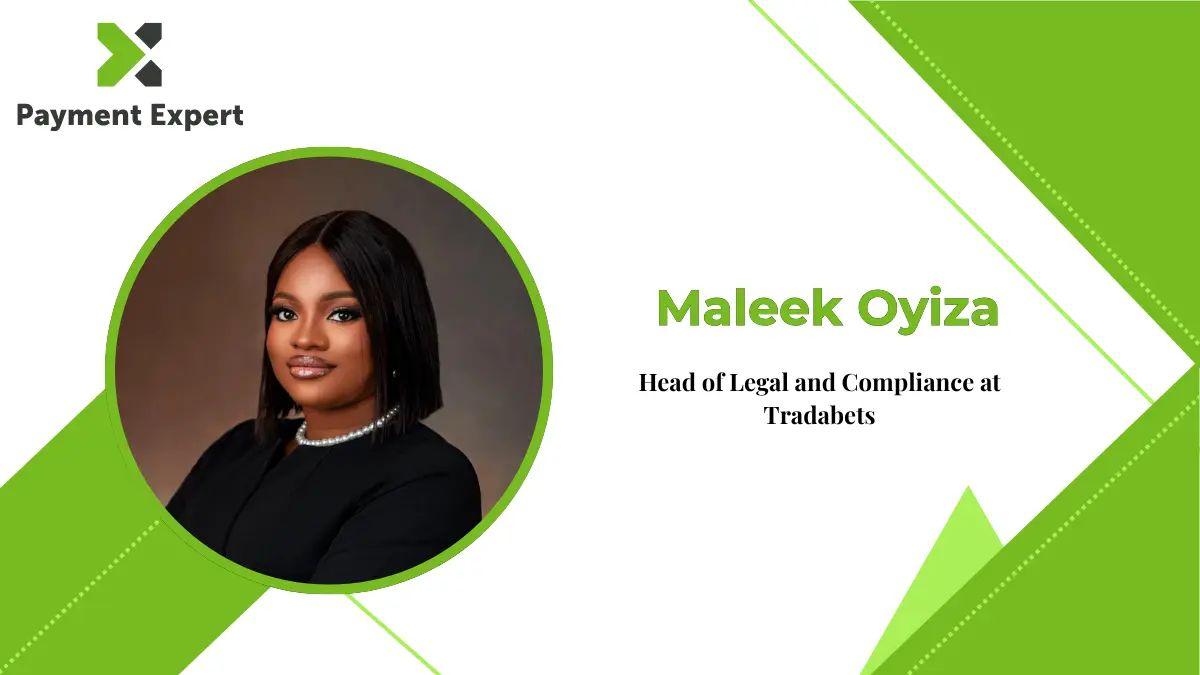
Ahead of the SBC Summit, Payment Expert spoke to Maleek Oyiza, Head of Legal and Compliance at Tradabets, about the regulatory and anti-money laundering landscape across African gaming markets.
Mobile money, fragmented cross-border regulations and the balance between frictionless player experiences and rigid verification are impacting compliance across the continent.
Tradabets’ Oyiza explains why a blanket strategy fails in Africa and how group-level compliance frameworks have to adapt to local realities.
Read the full interview below
Mobile money and alternative payment methods are now key to how African players deposit and withdraw – how has that changed the compliance work your team does compared with card or bank-based markets?
MO: It has definitely made compliance more dynamic. In a traditional card or bank-based environment, you usually have a fairly established trail and familiar banking controls. With mobile money and other alternative payment methods, the ecosystem is much more fragmented.
For us, that means we have to pay closer attention not just to who the customer is, but also to how money is moving, where it is coming from, where it is going, and whether the transaction makes sense in the context of the customer’s profile and betting activity.
The other important thing is that payment behaviour can vary significantly from one African market to another. So compliance cannot simply be copied and pasted from a European or North American model. We have to understand the local payment ecosystem and build our controls around the actual risks we are seeing.
What are the specific AML risks that come with mobile money that operators moving into Africa from other regions tend to underestimate?
MO: One of the biggest things operators underestimate is the speed and volume of transactions. Mobile money makes it very easy to move relatively small amounts frequently, and when you look at individual transactions in isolation, they may not immediately appear suspicious.
The risk becomes clearer when you look at the overall pattern.
You can have multiple accounts, unusual deposit and withdrawal patterns, third-party funding, or transactions that don’t really align with the customer’s normal activity. So transaction monitoring becomes extremely important.
Another issue is that operators sometimes assume that because a payment provider has already conducted KYC, their own AML obligations are somehow covered. That isn’t necessarily the case. The operator still has responsibility for understanding its customer and monitoring activity on its platform.
As Tradabets expands across borders, how do you manage compliance when AML rules, KYC standards, and regulator expectations differ so widely from one African market to the next?
MO: At the moment, Tradabets is still operating in Nigeria, so we are focused primarily on ensuring that our operations are fully aligned with the Nigerian regulatory and AML framework. However, as we look at expansion into other African markets, we understand that we cannot assume that the Nigerian approach will simply apply everywhere else.
Our approach is to build a strong compliance framework from the beginning, based on principles such as KYC, customer due diligence, transaction monitoring, responsible gaming and AML controls, while recognising that the specific requirements will need to be adapted to each jurisdiction.
For example, when we enter a new market, we would first look at the local licensing requirements, the regulator’s expectations, KYC thresholds, AML reporting obligations and the particular risks associated with that market and its payment ecosystem.
So, rather than having a completely different compliance programme for every country, the idea is to have a consistent group-level framework with the flexibility to localise it where necessary.
I think that is particularly important in Africa because you cannot really talk about ‘the African market’ as if it is one regulatory environment. Each country has its own legal and regulatory realities, and compliance has to respect those differences while maintaining the same overall standard of integrity and customer protection.

Where does the tension between a fast, seamless payment experience and thorough compliance checks bite hardest, and how do you resolve it without pushing players toward informal channels?
MO: This is probably one of the biggest practical challenges.
Players want to deposit and withdraw quickly. They don’t necessarily care about the compliance process happening behind the scenes, and from their perspective, an additional verification step can sometimes feel like friction. But compliance cannot simply be sacrificed for convenience.
The solution is really about making compliance as intelligent and proportionate as possible. A low-risk customer with normal activity shouldn’t necessarily experience the same level of friction as a customer whose behaviour triggers multiple risk indicators.
Technology helps with that because you can automate a lot of the initial checks and reserve deeper reviews for transactions or customers that actually require them.
The objective is not to make compliance invisible; it’s to make it efficient. If you build the right controls, you can protect the business without creating unnecessary obstacles for legitimate players.
How much of your cross-border compliance can you standardise into one framework, and how much has to be built country by country?
MO: I would say a significant part can be standardised, but the last mile always has to be local.
Your internal AML policy, risk assessment methodology, governance structure, training and general KYC principles can be standardised across the group.
Where things change is in licensing conditions, reporting requirements, regulator expectations, documentation, local payment methods and sometimes the actual definition of what constitutes higher risk.
So we don’t look at localisation as rebuilding the compliance programme from scratch every time we enter a new market. We take the existing framework and adapt it to the specific jurisdiction.
That gives you consistency without ignoring local law.
What role are local payment providers and regtech partners playing in helping you meet AML obligations, and what’s still missing from what the market offers?
MO: They play a very important role because they provide access to the infrastructure that actually makes these transactions possible. They can also provide useful data and transaction-level information that supports monitoring.
Regtech is particularly valuable for things like identity verification, sanctions screening, transaction monitoring and risk scoring. It allows compliance teams to deal with large volumes of data much more efficiently.
Where I think there is still room for improvement is interoperability and data quality.
African markets are diverse, and sometimes the systems don’t communicate with each other as efficiently as they should. Better data sharing, stronger APIs, more consistent verification standards and solutions that are genuinely designed around African payment behaviour would make compliance much more effective.
What do you want operators and regulators at SBC Summit 2026 to understand about compliance in African gaming markets that gets overlooked in wider industry conversations?
MO: I think the biggest thing is that Africa should not be treated as one single gaming market.
There are common themes across the continent, but the regulatory environments, payment ecosystems, customer behaviour and enforcement approaches can be very different from one country to another.
The other point is that compliance shouldn’t be viewed simply as a cost or an obstacle to growth. If you’re entering African markets, good compliance is actually part of building a sustainable business.
Operators need to understand the local market, work constructively with regulators, invest in technology and build relationships with credible local partners.
And from the regulatory side, I think continued engagement with operators is important because regulation works best when it understands how the market actually operates.
Ultimately, the goal should be a gaming environment that is commercially viable, protects players, prevents financial crime and gives responsible operators the confidence to invest for the long term.
Held in Lisbon from 29 September to 1 October 2026, SBC Summit is one of the world’s largest gatherings of betting and gaming professionals.
The event will bring together 40,000 attendees from across the industry for three days of learning, networking, and discussion, alongside a major exhibition featuring leading brands from around the globe.
For more information and tickets, visit sbcevents.com/sbc-summit.
Source: Payment Expert