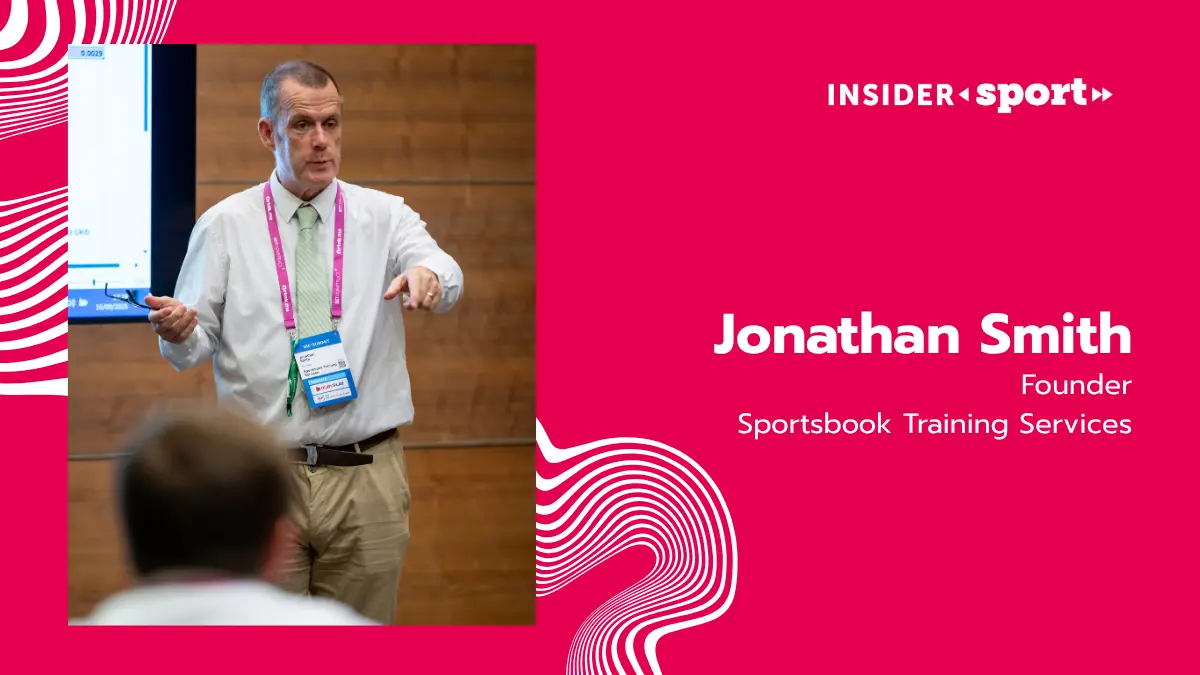
Sportsbook Training Services’ founder Jonathan Smith on how the internet changed odds making, why operators rely on data less than they think, and the case for in-house compiling ahead of SBC Summit 2026
Odds compiling ran in-house before the internet, handled by compilers working without the third-party data feeds operators depend on today.
Jonathan Smith, founder of Sportsbook Training Services, spent more than 25 years as a senior odds compiler at UK fixed-odds and spread-betting firms before that shift. He says the internet forced operators into a 24/7 global service, which brought in third-party suppliers such as Sportradar and Genius Sports.
Smith argues operators are less reliant on data than assumed, because operators themselves are often not the originators of the odds they offer. As founder of Sportsbook Training Services, he now teaches traders and builds pricing models for operators and suppliers, and will run a Sportsbook Trading Masterclass across three sessions at SBC Summit 2026 in Lisbon.

Ahead of his appearance, Insider Sport spoke to Smith about how the internet changed odds making, how reliant operators really are on data, how compiling methods differ between markets, and why he expects more operators to bring odds compilation in-house.
For more details on your chance to attend SBC Summit 2026, and hear from Sportsbook Training Services’ Jonathan Smith in person, follow the link HERE for more details.
Read the full interview with Smith below.
Firstly, Jonathan, odds making has evolved so much over time. What have been some of the most prominent changes over the last several years?
One innovation turned the industry on its head – the internet. Yes, I am old enough to remember sports betting prior to the internet! Once it arrived, the requirement to provide a global 24/7 service meant that operators would need wholesale help. That help arrived in the form of third parties such as Sport Radar, Genius Sports and many others. Nowadays we have a product whose lifecycle is so far removed from the days when I was a simple odds compiler, even if the underlying principles remain the same.
While the proliferation of data has informed the modern-day odds maker, how reliant are operators today on data for odds, and how could they leverage other technologies to not become so reliant?
Operators themselves are less reliant than you might think, as they are often not the originators of odds. For those who are (the B2B suppliers), good data allows you to make better estimates, and that is all a price ever is; our best guess at how likely we think something is.
What are some of the key developments happening in market prices over the last several years? Has the popularity of player props, in-play odds affected these over time?
Player props and in-play betting speak to a generation whose attention is drawn to markets that have an instantaneous response and resolution. While you may think the industry is changing fast, we have been talking about and developing these ideas for nearly two decades to the point where sports betting is focused around these high margin player friendly products above all else.
For non-UK operators, are there market-specific odds compiling methods that people should be focusing on, and how do these differ market to market?
From my experience, customers in different jurisdictions take time to adapt to innovations that UK operators assume will be of interest to them. What works in this country may be of limited appeal in a retail environment in Croatia or Nigeria for example. It would be a mistake to assume that a license to operate in a new country will entitle you to introduce a carbon copy of a UK model and expect the same outcome.
With Sportsbook Training Services, what compelled you to create the company, and what are some of the most common mistakes operators continue to make when creating odds?
I didn’t know how to do anything else and I still don’t! I have spent my whole professional life in odds compiling and am lucky enough that people still find it interesting enough to work with me. As for mistakes, we all make them. The biggest one for operators is that nowadays they hire third parties to make those mistakes for them rather than make them in-house. There’s nothing wrong with making mistakes provided you learn from them.
You are conducting a Sportsbook Trading Masterclass at SBC Summit 2026. Could you give us a taste of what some of the theoretical and practical applications you will demonstrate in order to boost attendees’ understanding of odds compiling?
Wherever I go, there is an appetite among people to learn about what makes the sports betting industry function; namely probability. So in all three classes, I will be demonstrating how a little knowledge, some common sense and a bit of data can take you a long way. If you really want to understand what sports betting is, then trying it for yourself is the best way.
At SBC Summit in Lisbon, what are some of the different discussions you are hoping will be had on odds compiling to take the practice forward in the future?
The theory of odds compilation doesn’t change. The provision of it – how and where it is arrived at – does change though, and I have been around long enough to think that operators are now beginning to decide that ownership of more of their product in-house is a good idea. Odds compilation forms part of that process and I hope people will come and visit my stand to talk to me about it.
Held in Lisbon from 29 September to 1 October 2026, SBC Summit is one of the world’s largest gatherings of betting and gaming professionals.
The event will bring together 40,000 attendees from across the industry for three days of learning, networking, and discussion, alongside a major exhibition featuring leading brands from around the globe.
For more information and tickets, visit sbcevents.com/sbc-summit.
Source: Insider Sport